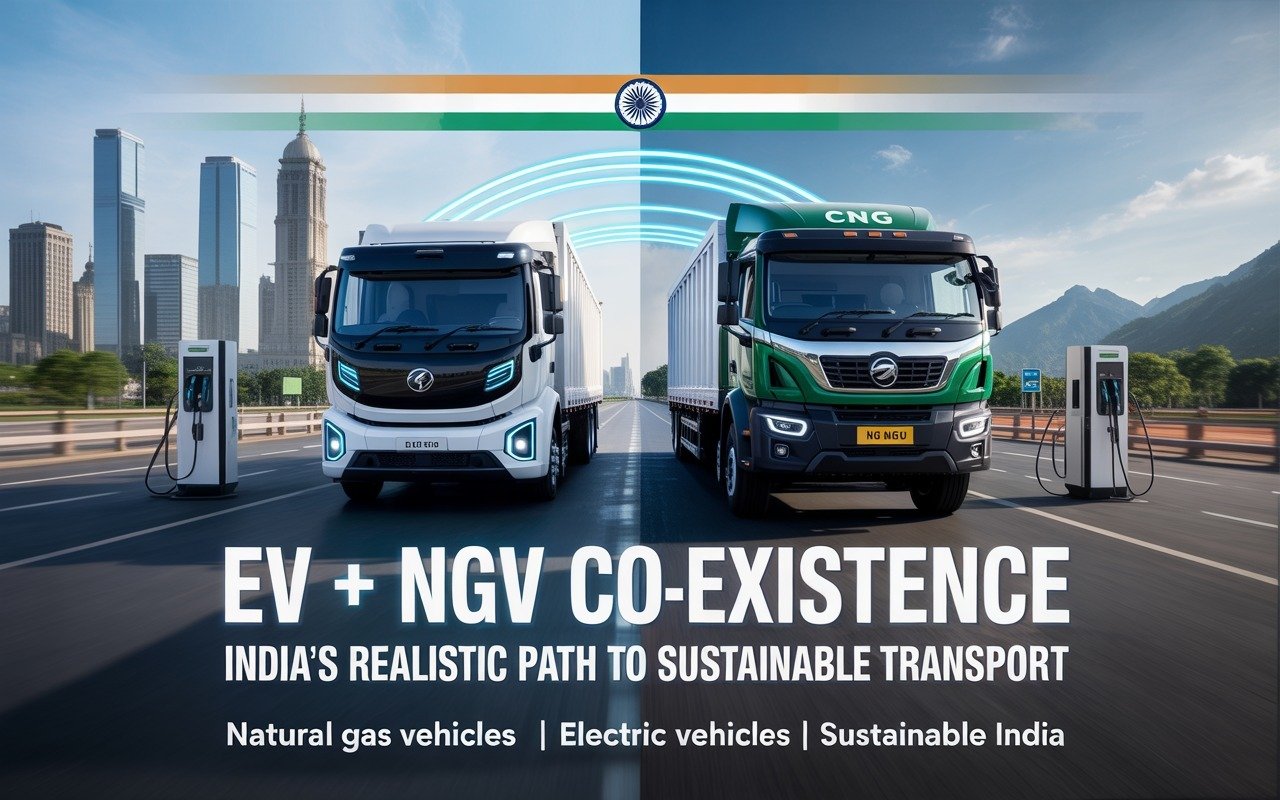
Natural Gas Vehicles Manufacturer in India is not just a business keyword. It is the actual starting point of India’s future mobility story. Every time I speak to fleet operators, drivers or even small logistics companies they all say one thing. India is moving toward a dual energy future and not a single fuel revolution. The country needs both electric vehicle technology and natural gas mobility to function smoothly. And honestly after observing the Indian transport landscape for years this makes complete sense.
People often imagine that one technology will suddenly replace everything we use today. But India does not work like that. The geography, the climate, income groups, road conditions and transport demands differ drastically from region to region. That is exactly why EV alone cannot hold the entire burden of movement. And that is why NGV will not disappear even with rapid electrification. India will always be a country where EV NGV co existence is not an option but a requirement.
When I first started studying this pattern I found something very clear. The day the government announced huge EV incentives the demand for CNG and LNG commercial vehicles also increased instead of dropping. At first it looked contradictory. But in reality businesses were simply balancing their fleets. They were choosing EV for short predictable city movement and NGV for long stable routes. And that is exactly the transformation we are witnessing today.
A natural gas vehicles manufacturer in India understands real transport challenges better than any policy document ever written. They know that Indian trucks, buses and commercial vehicles must handle heavy loads, inconsistent roads and long operating hours. And natural gas vehicles genuinely fit into this requirement.
During an interview in Pune a logistics operator told me something that stayed in my mind. His electric trucks were excellent for short routes but once he had to send vehicles beyond 300 or 400 kilometres he trusted NGV more. Charging was an issue. Charging time was a bigger issue. And the rural charging network was practically zero.
But NGV on the other hand provided stable predictable running. Fleet managers are not just thinking about sustainability. They think about downtime fuel reliability and route certainty. A natural gas vehicles manufacturer in India provides technology that respects these ground realities.
I personally love using an electric vehicle. The smooth drive, the quiet cabin and the low running cost are all amazing. But we cannot ignore the truth. An EV is still not the perfect solution for every Indian route.
In cities EVs are perfect. For metro fleets and office commuters EVs work like magic. But for industries like mining long haul logistics heavy goods movement cold supply chain or rural supply routes EV still struggles. And I am not saying this based on theory. This is based on discussions with real transport workers across India.
This is exactly why sustainable mobility experts strongly support sustainable transport India policies that include both EV and NGV.
The future of Indian mobility depends on EV NGV co existence. This model is simple and effective
Electric vehicles for cities short distances clean air zones and last mile logistics
NGV for long routes heavy duty work intercity freight and continuous commercial operations
Both technologies reduce pollution but in different ways and in different environments. The more I observe market patterns the clearer it becomes that India is naturally moving toward a dual solution without forcing it.
A natural gas vehicles manufacturer in India is not competing with an EV company. They are building complementary strengths that help different sectors. India is too large and too diverse to depend on a single energy source. Dual adoption protects the economy and ensures sustainable mobility.
This is why the combined model of EV plus NGV is attracting global attention. Many experts studying sustainable transport India trends have said that India may become a global example of balanced clean mobility.
Whenever global experts discuss which countries are creating impactful real world mobility strategies one category always considered is the global sustainable transport award. The award recognises countries and regions implementing scalable sustainable solutions without disrupting economic stability.
India stands out because it promotes EV and NGV growth together. This balanced approach is exactly why India is becoming a case study worldwide. Instead of copying Western single fuel model India is building its own hybrid path. And this strategy aligns perfectly with global sustainability expectations.
Policies and innovation matter. But the drivers, mechanics, fleet workers and technicians matter even more. Awards like the transport workers award highlight the contribution of real people who operate and maintain these vehicles.
During my conversations many transport workers told me why they prefer NGV for long distances. They trust its reliability. They know the refueling time. They know the range. And the same people also like EV for urban driving because it reduces fatigue and creates a smoother experience.
These ground experiences perfectly support the idea that both EV and NGV are necessary.
| Feature | Electric Vehicle | Natural Gas Vehicle |
| Best Usage | City and metro routes | Long haul and intercity |
| Refueling Time | Slow depending on chargers | Fast 5 to 7 minutes |
| Range Stability | Affected by load and temperature | Stable range |
| Fuel Infrastructure | Growing | Strongly established |
| Ideal For | Last mile delivery and cabs | Logistics commercial fleets |
| Maintenance | Battery sensitive | Engine stable and predictable |
This table is not theory. It is based on feedback from real transport operators.
If you look at market data both EV and NGV growth curves are rising together. Battery companies are partnering with fleet operators while natural gas manufacturers expand refueling networks. Many cities are promoting EV cabs while highways expand LNG and CNG stations.
This combined push builds a sustainable foundation for India. And this foundation is exactly what companies developing sustainable transport India strategies rely on.
Whenever someone asks me what India’s transport system will look like ten years from now I do not picture a future with only shiny electric cars or rows of charging stations. I imagine a balanced network where both electric vehicle fleets and natural gas fleets run side by side. That is the real future and honestly the only realistic path.
If we look at countries with mature transport systems each one follows a mixed energy model. No major economy depends on a single fuel. Even the biggest EV markets still rely heavily on natural gas and hybrid systems. It is almost strange that some people assume India should skip this balance and dive into one technology only. That is not how India’s geography or economics work.
A natural gas vehicles manufacturer in India is going to be just as important as battery manufacturers. Both will grow. Both will innovate. Both will help India reduce emissions without destroying economic efficiency.
The demand for NGV solutions continues to rise. Here is what I have personally observed from transport companies
A huge misconception is that EV running costs are always low. But for commercial trucks running 18 to 20 hours a day that is not always true. The cost of lost time at a charging station can be higher than the cost of fuel itself. That is where natural gas becomes a smarter choice.
A natural gas vehicle manufacturer in India typically produces engines with longer lifespan, lower maintenance sensitivity and strong torque consistency. These factors matter much more in commercial transport than just fuel type.
Companies operating across Karnataka, Gujarat, Haryana and Maharashtra have repeatedly stated that NGV remains the only stable option for freight work. And after seeing the data myself I agree with them.
Let us take a realistic look at electric vehicle limitations in commercial use. These are not criticisms. These are ground facts.
None of these mean that EV is bad. It simply means EV and NGV serve different roles.
Every time I discuss sustainable transport India strategies with fleet owners they say the same thing. EV is excellent for controlled routes like last mile delivery or office commute. But they do not risk it on unpredictable industrial routes.
This difference between controlled and uncontrolled routes is why India needs both systems.
Many policies are now openly supporting both NGV and EV. You will notice this in several government moves
This tells us something important. The country is preparing a long term transport model where EV NGV co existence is the permanent structure.
In fact experts who evaluate programs for the global sustainable transport award have praised India’s dual strategy for being realistic, adaptable and scalable.
After observing Indian transport from multiple angles technology economics infrastructure environmental needs and fleet operations one thing becomes very clear. India will not follow a single technology revolution. It will build a dual system where both electric vehicle fleets and natural gas fleets work together as equals.
A natural gas vehicles manufacturer in India will continue to power long routes heavy fleets and commercial operations. EV manufacturers will lead urban transformation through clean quiet mobility. Policies, drivers companies and global experts all support this direction.
This is not just a trend. It is the future. And it is the reason why sustainable transport India is becoming a global model for balanced mobility. It is also why EV NGV co existence is the strongest transport strategy India has ever adopted.
The future fleet of India will be dual powered, stable, economical and sustainable. And this future has already begun.